Recorded live
30 minutes
Free to watch · No registration
Watch the recordingCore Topics in CBT
The classic thought record and the skill of evaluating, rather than suppressing, unhelpful thoughts.
Recorded live
30 minutes
Free to watch · No registration
Watch the recording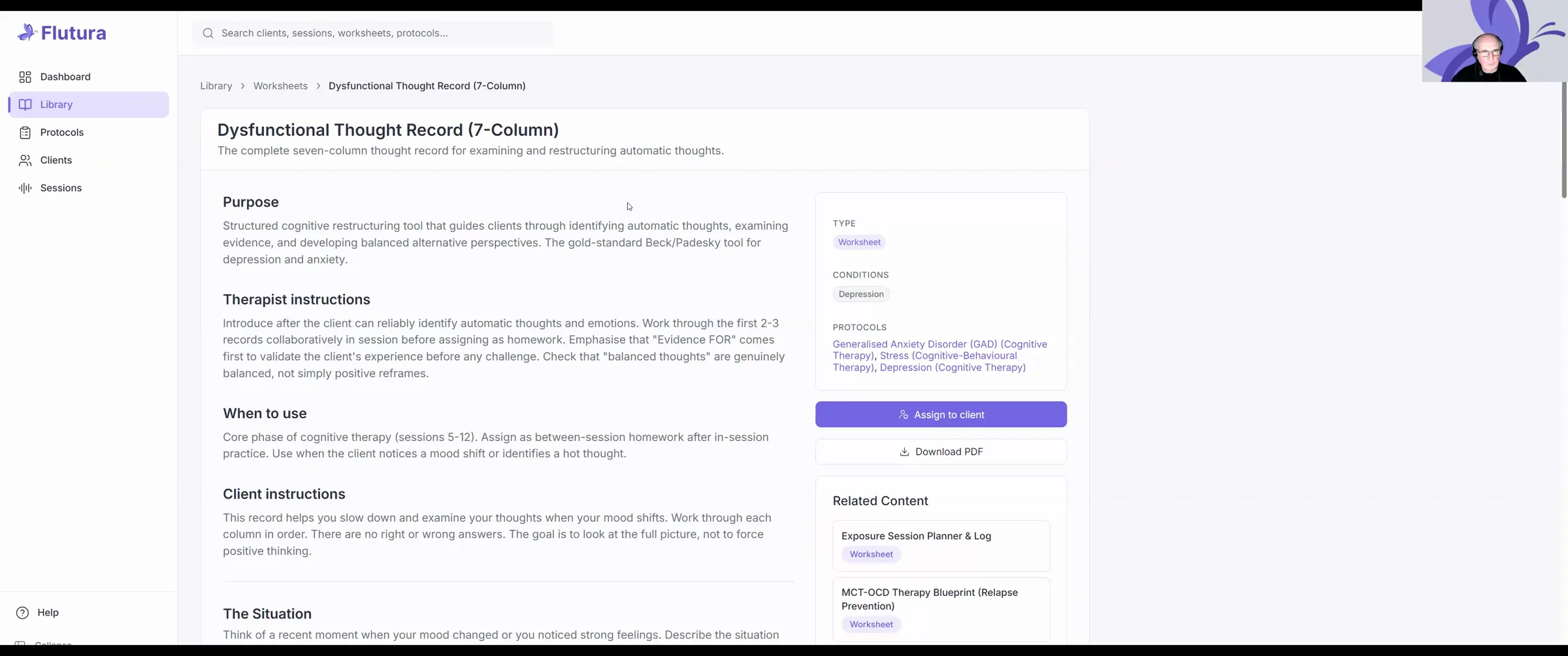
Patrick McGhee teaches cognitive restructuring through one seven-column thought record, worked from start to finish with a demo-account client, so every client named on screen is fictional.
He opens on how a client experiences an event. The sadness arrives, and the thought that someone is ignoring them sits so close to the event that it feels like part of it. The first task he describes is helping the client see that they are interpreting, that the interpretation can be biased, and that alternatives exist. He adds that showing a client this once is not enough: the client has to be able to do it alone, which is where homework that is easy to follow earns its place.
He then opens the Dysfunctional Thought Record in the Flutura library, reads the therapist instructions and assigns it to a client with a due date. On the client’s side the record runs in order: the situation, the automatic thoughts, the hot thought and how strongly it is believed, the emotions and their intensity, the evidence for the thought, the evidence against it, and a balanced thought, followed by a second rating of belief and emotion. He stresses that the evidence for comes first, because it validates the client’s experience before anything is challenged, and that a balanced thought is not a positive thought: it takes all the evidence into account.
On practice, he recommends one record in session and two or three at home, and gives two reasons seven-column records work: the insight they produce and the habit of balancing they build. He teaches mindfulness alongside restructuring so that a client notices sooner when thinking has drifted.
He closes inside Flutura with the treatment protocols, a simulated client’s scores tracked week by week, risk alerts drawn from PHQ-9, the dashboard and the library, then the price and the £1 trial.
Okay, so, welcome to… Cognitive restructuring, with me, Patrick McGhee, here at Practical CBT. Tonight, we're going to look at arguably the most fundamental and core element of working with a client.
We often associate thought restructuring with depression, but it's obviously much wider than that. It can be very powerful in depression, working alongside behavioural activation, activity scheduling. We've got another session coming up quite soon covering that element.
I want to take you through the concepts rather than the technology, but I want to do it through the technology, so you can see how it makes it easier for you, keeps you on the straight and narrow, and most importantly, makes it easier for the client compliance.
With homework is much higher when you do it this way, and you can keep track about what you've been doing with the client, and make sure that you're ready to go to the next step. Okay, so let's have a little think, first of all, about a fundamental idea that when a person has an experience, it's not a natural coded… Necessary reaction they give. If they see someone ignoring them, they think.
That they're being ignored because they're not a good person, and their emotional reaction is to feel Sad. That's not how the client experiences, of course, but the client experiences is, I felt sad because someone ignored me at work, or walking down the street.
And that subjective experience is self-perpetuating, because once you get that idea, then you keep seeing people ignoring you, because you just have that direct line between the visual experience of someone walking past you and not saying hello, and your subjective emotional experience of feeling bad.
But we know that's not actually what's happening. What's happening is that the client is almost subconsciously processing The meaning of that visual experience, that physical experience, that trigger event. They are interpreting the individual's Lack of eye contact with our deliberate, intentional, Transaction, socially, to avoid them.
Avoid decline. So, one of the first things we can do is try and get the client to recognize that they do have these thoughts. that they are… Biased? But they do lead to… Those emotional reactions, and that there are alternatives. And one of the things I think, which… We maybe don't go into enough in training and so on, and in,
in CPD is the fact that we don't want to leave it there. It's not enough to show the client that they can have a different perspective. and change their behavior, and that that will start to break the vicious circle and give them other options about how they interpret events. It's something they can do on their own if they get the right support, and that's really where
The very best of the systems for helping clients do homework come into their own Because it's not enough for you to do it once a week with the client in the session. They've got to be able to be confident about being able to be successful doing that by themselves. They've got to know how to do it, and it's got to be easy. As soon as you start making it complicated, the client is going to be struggling.
We know, for example, that people suffering from depression like a lot of structure in their face-to-face sessions with their therapist. And it's also very clear to me that people with depression are much more comfortable when they've got structure to the homework. But it's not just for people with depression. It's for all kinds of clients, whether it's generalized anxiety disorder. treating dysfunctional
Anger, whether it's aspects of low self-esteem, whether it's aspects of imposter syndrome, this basic issue comes back again and again. To show the client the immense power of thought? to show the client how hidden the thought process can be, and to show the client how to challenge those thoughts, and have a much more sophisticated perspective on what life is throwing at them. So.
Let's think about how we do this in practice. Now, this is straight from Flutura, this is straight into the library. It's one of over a hundred different, worksheets that you can use with your client, and indeed use it with yourself. We always recommend that you use it with yourself to get the hang of it. And… If you've not seen Flutura before, you'll know that it's built up
with a whole set of clients that you, sign up on your system. Very easy for the client. They get an email, they click on it, they get in, they're done, and we'll see how it works in just a moment.
We have the overall system here with the statement of purpose that helps you stick on to the straight and narrow, helps the client understand they can come back to this. We've even given instructions for the therapist, so they know… you know what it is that you're trying to do here directly. Including really quite advanced concepts, which
is that you do need to be open to the evidence for it. I think a lot of therapists kind of skip that, or not exactly skip it, but they want to move on, because they know that these are the
dysfunctional thoughts, which are quite toxic, which the client is just being overwhelmed by them. So you kind of want to get away from it, but we shouldn't underestimate the validational importance of reflecting on the evidence for. So does that. We then just simply identify when to use it as part of the core phase of…
aspects of cognitive therapy, obviously. Instructions to the client. I won't read all these out, you can see it. The situation and what was happening and so on, we'll get to that in just a second. But the way it works is. I can read this, but in order to make it, real, then we're going to assign it to a client. So these are all made-up clients. I'm going to assign
this activity to Sarah Chen. I could assign it to more than one person. I find it very useful when I'm working with couples to assign the same exercise to more than one client. So I've picked Sarah Chen, click on Assign, it comes up.
this will assign this dysfunctional thought record to Sarah Chen, they'll be notified and can start straight away. Yeah, that's what I want to do. Assign it to her. I can put a date, I can say, you know, before our next session on Thursday, Sarah, I want you to have a go at this, please, if you don't mind, as we discussed it. So I'll put it down for 11th of November, which is the day before our next session.
Right? So she will now get a notification within your site. Now, I could have added a little text message explaining it, but I don't want to spend time doing that. That's now gone to Sarah. Now. If I pick up on this again, pick on Sarah again, sign it to her. Assign it to her, put in a message here. Hi, Sarah.
like today, as I say, it can be on the 11th. Confirm it. That's fine. And she's going to get, Nope. We've already filled this in, just to keep it clear here. So, what the client will get then on their app is the prompt for the situation.
And she might say it was Tuesday afternoon, I was sitting alone at home after cancelling plans with a friend. Now, you want to emphasise to clients that you don't need to have a fully detailed kind of, you know, as if you were there, description of the situation, about what happened. You don't need a whole backstory, you don't want to have the client going into what I thought might have happened was X,
but then what someone told me would happen was Y, and what actually happened was Z. You don't need that. It's interesting if the client wants to do that kind of level of rich processing, but it's not necessary at all. Then we get the question about when did it happen, which is very important, because when you build up a series of these, you'll want to help the client identify when their approach to
Thoughts and, emotions change, so it's good to have a log, and the system will automatically capture the, the record there. So then we start with the automatic thoughts. What thoughts or images went through your mind at that moment? Try to capture the exact words or pictures, especially the one that felt the strongest, the so-called hot thought. Again, we don't need lots and lots of detail.
We don't necessarily need a lot of different thoughts, we just need one or two to show the client the principle, which is why we emphasize the hot thought there.
And it's important to just recognize these automatic thoughts, because we want the client to recognize that these are things that are happening on autopilot. This is not what you sat down and thought about for an hour and decided was the right kind of thing to think, the right perspective to adopt. These happened almost instantaneously, and
so quickly that you weren't able to really consciously be alert to that. Now, you might be thinking to yourself, you know, that person is ignoring me. as an intrinsic feature of what's happening, you know, that's… I see a red apple, I see a blue poster, I see someone ignoring me. It's that same level of reality. What we're trying to get the client to recognize that
here is as, you know, it's against all their instincts, but actually, seeing someone ignoring you is not the same as seeing a red apple. The apple is intrinsically red. You don't have to do a lot of cognitive work to construe it as being read, but in the social sphere, of course, people
do actions in space, people move about, they say things, they look at things, and the social meaning, the significance to you, requires a bit of interpretation, and the client will accept that. The issue is that they're not seeing exactly what interpretations they're making, and they're not seeing it as being biased.
So, we then move on to what thought felt strongest, the hot foot. Which one of these was the most important one? And we've got the client here identifying the under 2.1, I'm such a letdown, nobody really wants to spend time with me, I always ruin things. And those are all kind of connected, we can see that, but we want the client to really focus.
And what the client has focused on here, Sarah said, is nobody really wants to spend time with me. Yeah, that is a major part of her interpretation of the world around her.
Then we've got a slider, we can move this to the right or left, if we're a client. So we can identify how strongly they believe the thought thought right now, all the way from 10, completely believe it, all the way down to 0. I don't believe it at all.
So the client's got that, it breaks it. Rather than just having them type in the number 10, it's quite fun for them to slide it, and this works very well on a mobile phone, of course. Then the emotions. What emotion did you feel at that moment? Name each one and rate how intense it was. You'll notice that we're not forcing the idea of, that thought caused the emotion, Sarah. Right? It's true.
And we want Sarah to finish up there. But we're not going to force it. Why? Because Socratic approaches are built into the system. We want the client to see for herself That the emotions emerged from her construal of the situation. So, what emotions did you feel? Sadness, guilt, loneliness. Okay, so, those are all important.
They're all interconnected, But which one would you rate as being the strongest? From 10, the most intense it could be. all the way down to zero, barely noticeable. And Sarah can move this one way or the other to indicate the level of intensity. So now we start to unpick it. We're trying to help Sarah by Making sure she recognizes that the foundation for that hot thought
That nobody wants to spend time with her. Is not well done. scaffolded at all. So what facts support the thought? Look for observable evidence, not feelings or assumptions, but facts.
This step validates your experience, talking to the client all the time. This step validates your experience before looking at the fuller picture. So, we're already making sure that Sarah's going to feel as though we're working with her, and we're not standing over her, pointing out all the mistakes that she's made. Now, I think there is a tendency sometimes, even for fairly experienced therapists.
to do a kind of didactic kind of teachy-teachy thing, and I get that, because there's a lot of educational work going on here. You're trying to help the client understand that things are not the way they look. you cannot be direct in that. You've got to take it step by step. You've got to help the client validate their, their experiences.
And you want to make sure that the client can lay out the evidence so they can join up the dots, so… Sarah says, I did cancel on my friend. I've canceled twice this month. My friend sounded disappointment. Disappointed on the phone. So… That's the evidence that supports the thought, that there's a lot of cancelling going on. But what's the evidence against the hot thought?
I mean, what… what Sarah's doing is saying, well, I canceled my friend because that's… I didn't think she wanted to be with me at all. Who would? So, okay.
We've done one side of it. Always quite useful, I think, to make it a kind of a natural thing to look at the other side. If you say, okay, we've looked at the evidence for, what about looking at the evidence against? You can do that, but it's quite nice to make it a natural thing, so you can say, okay, we've looked at that side of it, let's look at the other side of it.
I'll talk even about the scales of justice and so on, but that can be overdone. The scales thing is done in textbooks quite a lot, but I think that's just so they can use the graphic to break up the text on the page, it's not necessarily a… A helpful metaphor. So, what facts suggest this thought might not be the complete picture. Notice we're not saying.
extra facts that prove your facts wrong. You're wrong, Sarah. You think you've got the facts, but you're not. The facts are… that's not what we're doing. We're saying her picture is incomplete, and that's really important to remember that, I suggest, because if you can get Sarah to understand the idea that her thoughts are valid, but incomplete. Then she's going to be much more open to the idea of balance.
Rather than the idea of eradication, that she got it wrong. She'd completely… Now, you know and I know that sometimes people's thoughts are not just partial, just part… they are very intensely extreme, and… wrong. But we don't want to push that too much. We're trying to get a very simple thing done here. We want to get… Sarah? Chen, our client, to be open to alternative additional
aspects of this situation so that they can be a counterbalancing measure. That's all we need to open up. And unfreeze some assumptions. So what evidence goes against this thought? Well, my friend texted later to check I was okay, which suggests he do care. Last week, we had a good time together. Other friends have invited me out recently. Right? Doesn't take… we don't… we don't want a whole…
War and peace about why, now you've mentioned it, yeah, actually, there are counter-suggestions. Now, again, really important. We've got to keep that metaphor of balance. Right? Because the whole idea of cognitive behavioral therapy, all the research, all the clinical practice shows one thing. If you try and get rid of positive thoughts with negative thoughts, it won't work. It'll come back.
We're not trying to get rid of those negative thoughts at all, what does I say? Yeah, we don't want to be simply trying to get rid of negative thoughts and put positive thoughts into place.
We want to try and get the positive thoughts to balance the negative thoughts, because life is full of ups and downs, and things that you like, and things you don't like. To make it more impactful, we want to make sure that Sarah's able to understand and apply the idea of a balanced approach, a balanced perspective. So, based on the evidence from both sites.
What is a more balanced way of seeing this? A balanced thought is not a positive thought. It takes all the evidence into account, and that's important, not… because quite often, I think clients come to us having had a helpful friend.
Saying, oh, come on, you've got a great husband, and you've got this fantastic car, and a great job. Why would you be upset about anything? Like, not really helpful. I'm exaggerating for effect, but it does happen. Because despite the…
general public and ourselves, sometimes we do it, I'm sure, even with our training. We're trying to get rid of one idea and put a different idea in its place, but that's not going to work.
Because if that worked, they wouldn't need a therapist, right? It's already quite a robust, quite a resilient perspective. We want to get the client to recognize it's incomplete and would be better with other points of view. So, what is the more balanced thought? Well. I cancel today, and that's not ideal, but one cancellation doesn't mean nobody wants me around.
My friend checked in afterwards, which showed they care. So, I've not let everyone down, I've not broken all my social networks, I've not become alienated from my friends. I'm not being ostracized because I didn't go along to the thing. I just didn't go along to the thing, and that's it. The two things sit side by side. It's not ideal.
But it doesn't mean nobody wants me around. My friend did check in afterwards, which shows they care. Now, Sarah, having had a bit of balancing, getting to feel the picture, now, how much do you believe this balanced thought, I believe it quite a lot, not very much, but it will be more. Now, you can really do something important here, which is go back and…
rate the emotions, ask Sarah, she'll be rating it herself, of course, on her own, as homework, to rate how much she now feels sad, depressed. And it's going to be a lot less than it was originally. It won't be zero, we don't need it to be, but it will be a lot less than it was initially.
Do you notice any new or different emotions? Yes. Still some sadness, but also a bit of relief. And clients do talk about relief. It's a sense of Oh, I can do something about this. There is another way of looking at it.
Because clients will run down that road of what's called fantasy training. They'll keep thinking about the consequences of an action, and keep catastrophizing until there's a big, long chain of negative events. And just stopping that is going to be very, very powerful indeed. So, we want to make sure we don't leave it there.
We want to help the client build the skills, so each time you complete a new thought record, work through all 7 steps from the beginning. on your own. Repeating this process across different situations, because that will help you spot patterns in your thinking over time, as Judith Beck pointed out. So, the way… and there are different ways you can do it here, and I kind of, you know, emphasized
As I've gone through that, the two different ways of doing it. The way I recommend to you, but it might be important for you to think about it, is to do one of these with the client in session, whether it's a telesession over Zoom or a face-to-face session. Go with the app, And if you're not using the app, if you're using something else, then do it.
In session. And then… that's a lot easier with the app, of course. If you do it then, as homework, get the client to do 2 or 3 of these. not more than three, you know, three would be, enough, really, at home. And so they get into the habit of doing it, because I think there's a really interesting kind of… textbooks, I think, get into a muddle over this.
Thought record works, seven-column thought records, like I've described, do work very well, but they work for two reasons, and not just one reason. A lot of textbooks emphasise the idea that because the client recognizes that their thoughts are biased, and the balanced approach is more realistic and powerful, that they suddenly have a deep. And broad-based insight into how they should deal with
uncertain, ambiguous, or apparently superficially negative experiences. And that's true, that in itself is not wrong, it's just not enough, because there's something else going on. The second dynamic of benefit around 7-column thought records is this, that you want to get the client into a habit of balancing.
balancing act. Because it's not enough for the client to be in a position whereby, had they sat down and thought about the additional evidence they've been ignoring, they would have been fined, they just didn't get around to doing it, is not very therapeutically Impressive. So you want to get the client to do the two things. You want them to have the insight into the
Promise of a new way of looking at their everyday life. And that will happen after just one. of these, and, you know, Christine Padesky's got a classic paper on, you know, doing this in your first session with the, a simpler version.
the five boxes, etc. But it's the same idea. The first time the client does it, suddenly, it's revelatory. But it's not enough. It's necessary, but it's not sufficient. You also need the client to get into the habit of doing it, so it becomes their routine way of dealing with the world around them. They… and the client will generally grow stronger, knowing that they can do this. That sense of mastery.
become second nature. It's not one of those things where you say, of course I could have used that little technique that my therapist showed me. No, you want them to do it routinely.
It has to be the first thing they go to when they feel a little bit under pressure. Which is why, I won't go into this now, but I'm sure you're familiar with the concept. This is why I always try and teach a bit of mindfulness alongside of Cognitive challenge, Cognitive Restructuring, Unhelpful thinking styles, because the mindfulness allows the client to spot
Drifting into an unbalanced negative thought set a lot earlier. Because mindfulness, as they say, is the ability to know what's going on in your head at any given moment without being overwhelmed by it. So if you do the mindfulness meditation. Where you bring your conscious awareness back to your breathing, and you just…
Observe it, wandering, and bring it back. Observe it, wandering, bring it back. If you do that daily for 5 minutes, you will start then on every day to recognize when your attention is… when you go into autopilot and start seeing bad stuff, and you start criticizing yourself.
You want to take over the controls of the plane, so to speak, not be an autopilot, and apply your seven-column thought record system around counterbalancing. So this is what you get in the app. It's all very interactive, it's all very tight. What you'll be able to do is, be able to do it within the context of a treatment protocol. So.
We've got all the protocols there that you would expect. GAD, health anxiety, PTSD, specific phobias, OCD, and so on. We've got all those, there. But if you look at clients now, if I go to Sarah Chen. We'll see that… As she does these exercises week by week, R. Depression score comes down.
you know, this is made up, this is a simulation, but this is very common. When you do the cognitive restructuring with clients who are depressed, the depression score does come down pretty rapidly. And, of course, we know that activity scheduling
Behavioral activation is very important in depression because of the kind of self-immobilizing effect of depression. We need to break that open, otherwise they won't have any experiences to reinterpret, to some extent. So, you do need to do the behavioral activation early on.
But having got that off and running, and the client is, you know, scheduling stuff all week, bring in the cognitive restructuring, bring in the seven-column thought record, bring in your Flutura app, allow the client to have the experience, as I say, in the session. But then they go away and do it on their own. And in Flutura, what will happen is you'll get, from the client side, a notification that they
whole thing has been set up. But if you want, and you don't have to do this, but you can add on notifications. So that the client is reminded every day, or every other day, just, whether or not they've done their actual Homework? And it will alert you.
If there's an issue. It also manages risk, or it will monitor risk, so that if Sarah doesn't get better, and she still feels she's going to harm herself in some way, and she's scoring on PHQ-9, it will alert you, and this will go red, and you'll be able to monitor that. So, it's very joined up.
I won't go into it now, we've done… we do different sessions on recording, but you can see here in the top right-hand corner, the three magic buttons, add a new client, dead easy. Record a session, and it will look… audio record, and then generate a transcript. I mean, there's no recording kept. It gets deleted. Assign a task to a client, as I showed you earlier, very straightforward.
The library, as I say, it's got worksheets. All organized by major conditions. Low self-esteem, we get all these here that are going to be helpful, everything from compassion-based, forgiving myself, all the way through to cognitive behavioral maps, in terms of what I talked about earlier about Christine Padesky, and then we get a little set of emotions here, if you want to do it that way.
And when you log on, this is what you get. You get a dashboard showing what everyone's up to. You can see if Sarah, Tino, Aisha, or Sean have done their homework or not. It can tell you when their next session is. You get an overview of how many, clients have…
done… what the average is across clients of their homework. You can see how many tasks have been assigned, or 8 in progress, etc, etc. So it might look a little bit busy just now, but it just helps you. These are all the things you've been doing recently, so you can click on that to see what it is. It's not a problem. It's a very helpful way of just getting into where you need to be.
Okay, so if you are interested in exploring the core elements of cognitive restructuring. We're going to send everyone their certificate, of course, but also a worksheet, just to get your head around the structure of it, but you don't want to be sending PDFs around to your clients, that's very,
kind of old school. You want to be using an app like… like Flutura, because it will allow you to do it in a much more systematic way. It will help you do it in a much more auditable way, but when you get audited, you'll be able to show exactly what you did and when and why. You'll be able to track risk an awful lot better. And of course, you'll be able to mobilize everything you need to for your Supervision.
This is the main website for Flutura, you just need to click on any of the links in the emails, and it just lays out all the systems, how they work, homework tax, the practice protocols, the monitoring, very straightforward. reaches the client, it cannot write what you didn't say, so you're protected in terms of, you know, what the client might misremember, and so on. People are using this, obviously, and it's all,
compliant. It's only £29 a month. We're trying to make sure that it's less than half the average price of a therapy session, so no one's been priced out of this. No, for £29 a month, I don't care how… much functionality you're, you're looking for in your previous apps. This one's got everything, and it's only half the price of a normal session.
We are running a special program at the moment. Well, you can get, for a pound, you can get the whole system to try it out, so there's no limit on the number of clients, no limit on the number of sessions that you record, no limits on the number of worksheets, no limits at all. You have it… the only limit is you have it for a month. And you'll be able to.
try it out in your own way, because everyone's therapy practice is different. You can work out if it's going to be the right thing for you.
Okay, if you do have any questions or comments, please do put them in the chat. But otherwise, thank you very much indeed for coming along today for this session on Cognitive Restructuring, the basic principles, the core ideas, and the way in which an app like Flutura can help. Look after yourselves, and I'll see you all again very soon indeed. Bye for now.
The session
How a client's interpretation of an event shapes the emotion that follows.
The seven-column thought record from the library, assigned to a client with a due date.
Each step in order: situation, automatic thoughts, the hot thought and a belief rating, emotions and their intensity, evidence for, evidence against, a balanced thought, and a second rating.
Why the evidence for the thought comes first, and why a balanced thought is not a positive thought.
One record in session, then two or three at home, and the two reasons Patrick gives for why seven-column records work.
Mindfulness taught alongside restructuring, so a client notices sooner when thinking drifts.
In Flutura: protocols, a client's scores tracked week by week with risk alerts, the dashboard and the library, then price and the £1 trial.

Who taught it
Chartered Psychologist and BABCP-accredited CBT therapist, 30 years across clinical practice, research and higher education. Assistant Vice Chancellor at the University of Greater Manchester and the author of The Ultimate CBT Handbook.
He co-founded Flutura.
Our storyThe schedule
Core Topics in CBT
Using activity and behaviour change to lift mood, independent of how a client currently feels.
£1 for the trial, then £29 a month. Cancel any time.